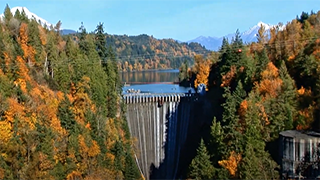


 Lower Baker dam
Protecting fish
Puget Sound Energy shares the Pacific Northwest's deep-rooted environmental ethic and embraces our responsibility to steward its valued natural resources while continuing to provide safe, clean, and reliable electricity.
This commitment includes protecting and conserving our cherished salmon runs.
Our biologists and fisheries specialists have worked for decades with Native American tribes and government agencies to boost salmon and trout populations, and to enhance aquatic habitats in river basins where PSE has hydropower operations.
The “How to” of salmon recovery at Baker River
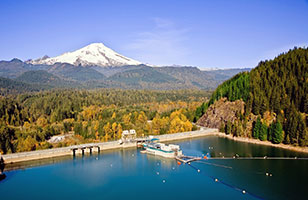
On Washington's Baker River, home to PSE's largest hydroelectric project, our substantial investment in fish restoration efforts have come to fruition.
Since dam construction in the early and mid-20th century, there has always been a trap-and-haul program in place for migrating fish at Baker River. The Lower Baker and Upper Baker dams are too high for conventional fish ladders, so PSE developed facilities and methods to capture and move Sockeye and Coho salmon around the dams.
PSE’s efforts allow them to continue their upriver movement as adults, or downstream as smolts - juvenile fish ready to migrate out to Puget Sound and Salish Sea. This “complete life cycle” approach to salmon recovery has three primary components, all working in tandem to benefit Baker River's once struggling salmon populations.
PSE expects to continue to grow the fish program into the future, reinvigorating this regionally important salmon stock, renewing harvest opportunities for local tribes and recreational fishers, and revitalizing the aquatic ecosystem of the Baker River basin.
Now, other regional, national, and international hydropower utility companies look to Puget Sound Energy’s successful Baker fisheries program when designing their own systems to conserve and protect native fish, while continuing to meet the growing need for clean energy.
More information:
Awards and Honors

-
Enhancing fish populations
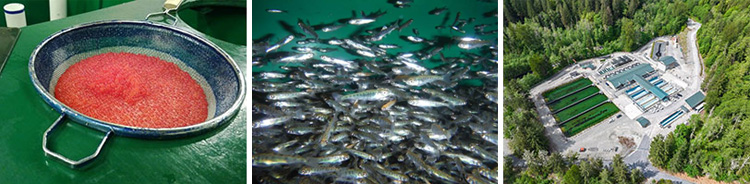
In recent decades, PSE constructed a new fish hatchery at Baker Lake that has capacity to produce up to 14.5 million salmon fry hatched in incubators from eggs each year.
We’ve also upgraded our Sockeye spawning beach. PSE’s first man-made spawning beach was located where Baker River enters the head of Baker Lake. Changing river conditions jeopardized that location, so we made the decision to bring the spawning beach “in house.”
Now located at the Baker Lake Fish Hatchery, this unique series of four gravel-bottomed pools percolate with cool, clean spring-fed water piped from the same source that supplies the hatchery, providing a controlled, predator-free environment for adult Sockeye. This “naturalized” beach greatly increases their spawning success, as it mimics some of the habitat that was inundated by rising lake levels behind the Upper Baker dam.
Millions of Sockeye and tens of thousands of Coho are hatched and raised for release into Lake Shannon and Baker Lake, where they feed and grow for a full year until they are ready to be captured as smolts, and moved below the dams.
-
Moving fish downstream
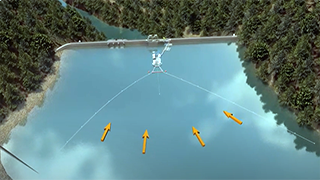
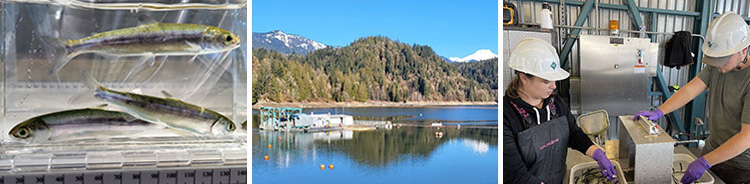
To accomplish this, we designed, built, and put into service the world’s first modern Floating Surface Collectors. These innovative machines operate in the reservoirs near both of our dams for half the year, with enormous pumps generating surface currents to attract and safely hold thousands of juvenile salmon each day.
Once counted and processed, the young salmon are trucked downstream below the dams by a fleet of PSE water tankers dubbed "the fish taxis."
Success! A record high juvenile fish out-migration occurred in 2025, with nearly 1.5 million young Sockeye salmon and 67K young Coho captured from the reservoirs and released into Baker River where it meets the Skagit River.
-
Moving fish upstream
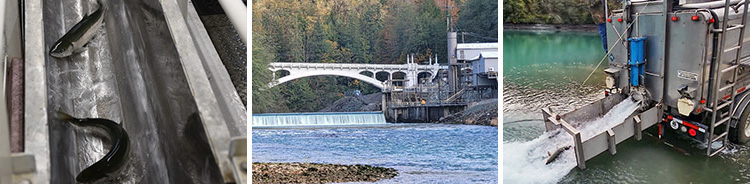
Jointly with the hatchery and downstream floating fish collectors, in 2010 we constructed and brought online an advanced Upstream Fish Trap. Located on Baker River in the town of Concrete, the purpose of this facility is to capture returning adult salmon.
After sorting and counting, our fish trucks safely haul Sockeye and Coho back upstream around the dams to the hatchery, with many more fish also released to Baker Lake.
Success! Since 2010, steadily increasing adult Sockeye salmon numbers culminated in the biggest run yet – nearly 93,000 Sockeye returned to the Skagit and Baker rivers in 2025.
All salmon have a natural variability year-to-year and while this number is encouraging, even more so is the fact that the most recent 5-year adult Sockeye average now exceeds 50,000 fish.
Check out how the Baker River Upstream Fish Trap works in this video
-
We all benefit
PSE expects to continue to grow the fish program into the future, reinvigorating this regionally important salmon stock, renewing harvest opportunities for local tribes and recreational fishers, and revitalizing the aquatic ecosystem of the Baker River basin.
Now, other regional, national, and international hydropower utility companies look to Puget Sound Energy’s successful Baker fisheries program when designing their own systems to conserve and protect native fish, while continuing to meet the growing need for clean energy.
More information:
Awards and Honors:
Baker River Project honored with prestigious National Hydropower Association award
-
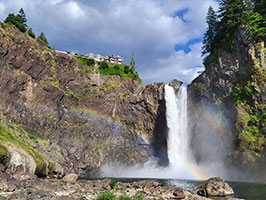
Snoqualmie River and Snoqualmie Falls
On the Snoqualmie River, home to our oldest hydropower generation plant, fish protection goes hand-in-hand with power generation.
We added new flow-control equipment in the Plant 2 powerhouse to ensure consistent outflows if an emergency shutdown occurs. This safety mechanism prevents rapid changes in downstream river levels that could potentially strand native fish.
Similarly, we installed a fish bypass pipe in the original Plant 1 (built 1898) to deliver uninterrupted oxygen-rich river water to the powerhouse outflow tunnel during short periods when the plant isn’t operating, such as for maintenance work or during emergencies. Fish that may have strayed into the tunnel (from the pool at the base of Snoqualmie Falls) are protected from harm.
We also manage riverside habitats to maintain shade trees, reduce invasive vegetation, and minimize impact in the very popular Snoqualmie Falls Park.
We recently provided King County with information to assist with their efforts to update flood management maps in and around the city of Snoqualmie. We conserve fish habitat along the Kimball Creek tributary and continue to support the Washington Department of Fish and Wildlife’s fish-enhancement program in the upper Snoqualmie River watershed.