
Severe flooding in our service area continues to create challenges for power restoration. Flooded roads, landslides, and unstable ground conditions are limiting safe access to damaged equipment for our repair crews. Our natural gas infrastructure may also be affected.

We have temporarily removed Estimated Time of Restoration information from our outage map for affected areas until we can safely assess damage and begin repairs. When our crews gain access and can start assessing damage, they will provide information to be reflected on the outage map as to when to expect restored service. As weather allows, we are using drones and helicopters to patrol unreachable areas by air.

While weather conditions are currently calm, another round of rain and wind is expected on Monday, which may impact our crews' ability to continue restoration work safely as well as result in more outages. We are closely monitoring the situation and will adjust our response as needed. We will have crews ready to respond as any new outages occur.

We appreciate your patience during this time. The safety of our crews and customers is our top priority, and we are committed to restoring power as quickly and safely as possible. We will continue providing updates as our restoration efforts progress.

Visit PSE’s Alerts and Advisories page for information on our response efforts: pse.com/alerts.


alert 

Safety first. Never touch or go within 35 feet of downed power lines because they might be energized. Call PSE at 1-888-225-5773 or 911 to report problems.

Report and track power outages online

LED is best; here's why

A light-emitting diode (LED) bulb is an energy-efficient light bulb that generates light from the movement of electrons through a semiconductor.

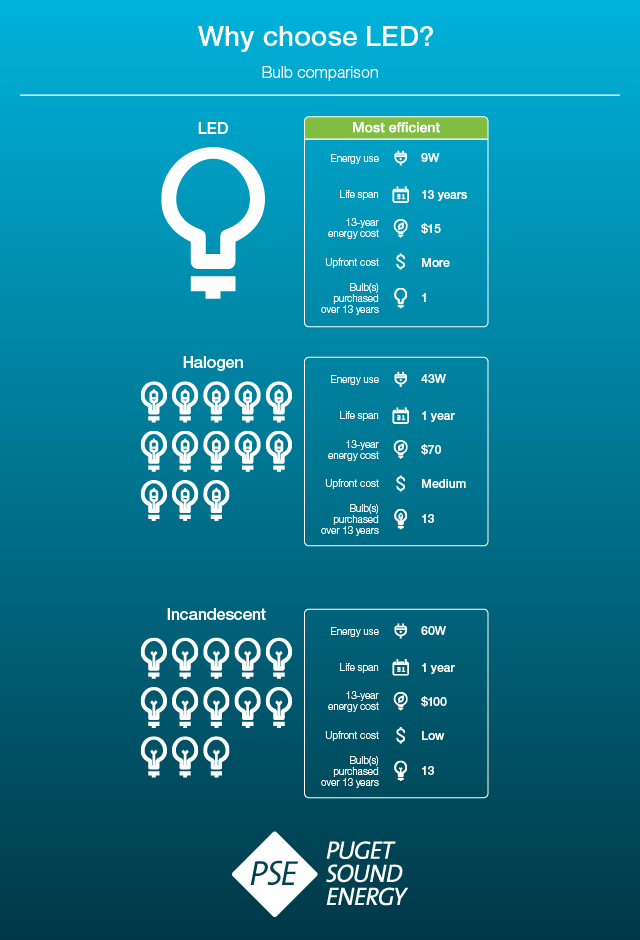
LED bulbs use at least 80 percent less energy than traditional incandescent bulbs and can last 13-25 years longer. LED bulbs are more energy-efficient than any other type of light bulb on the market (see our comparison infographic below). LEDs are environmentally friendly, too, which means you can safely dispose of them in the trash.

And did you also know:

  • LED bulbs use at least 80 percent less energy while producing the same quality and brightness of light that customers are used to getting from old incandescent and CFL bulbs.
  • LED bulbs have dimmable options that help you use even less energy. Be sure to use dimmable bulbs in dimmable fixtures.
  • You can use an energy-efficient LED bulb as a stronger light source without exceeding a fixture's maximum-rated wattage — great for boosting brightness in less well-lit areas.
  • LED bulbs last 13-25 years longer than incandescent bulbs. Their extended lifetime means fewer stores to visit and bulbs to buy in the long run.
  • Today's LED bulbs turn on immediately and do not flicker or buzz.

Check out our LED bulb FAQ for more in-depth info.

Bulb comparison
Bulb comparison