

Baker River Hydroelectric Project
-
Project updates: Modernization and safety work
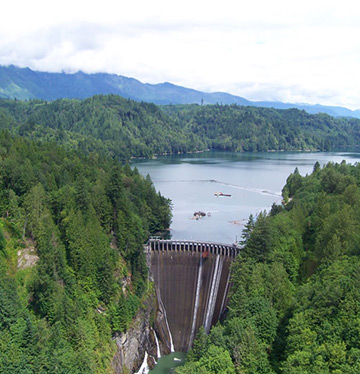
We’re working on modernization and safety projects at the Lower Baker Dam. This work helps us maintain the dam’s structural integrity so we can deliver safe and reliable hydroelectric power to customers for decades to come.
Seepage reduction project: Completed 2026
We finished installing a grout curtain to reduce seepage in early 2026. This involved fortifying the dam by injecting cementitious and bituminous grout to seal rock fractures.Crest improvement project: Started November 2026
The crest improvement project at the Lower Baker Dam is underway. The work will occur in two phases:Phase 1: Mobilization (current)
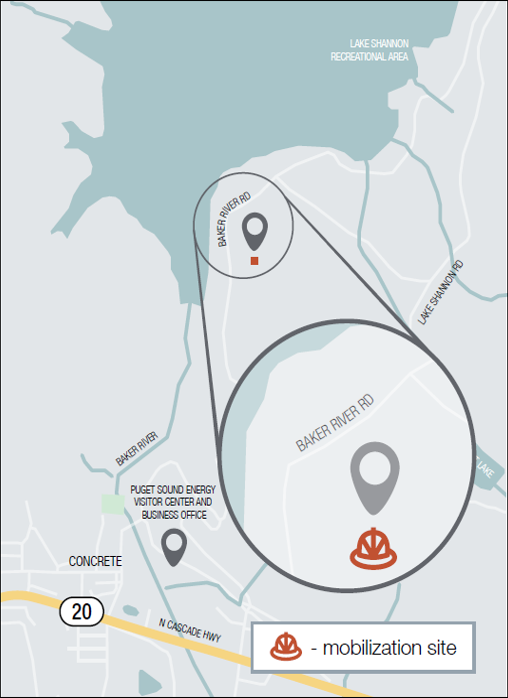
To prepare the site for work, crews are completing mobilization and site preparation activities, including installing project signage, temporary erosion control best management practices (BMPs), security fencing, temporary utilities and site offices. We are also scheduled to set up marine equipment (barges, crane and mooring anchors) and land-based cranes during this phase. Work is expected to begin in early November and take approximately 6 months to complete.Mobilization work
What: Mobilizing and staging equipment and crews
When: Expected November 2026 to April 2027
Work hours are typically Monday to Friday, 7 a.m. – 5 p.m.
Where: Lower Baker Dam FacilityWhat you can expect
- Increased traffic and noise from trucks along Highway 20 and Baker River Road
- Continued access to the boat launch which will remain open throughout construction
Phase 2: Construction (April 2027)
Once mobilization and site prep activities are complete, crews will begin construction. Construction is expected to take approximately four years to complete.Construction work will include:
- Widening spillway gates and increasing gate height, taking the number of gates from 23 to 12. This will reduce debris obstruction and improve water flow.
- Upgrading spillway gate machinery to allow for safe and efficient remote operation.
- Improving access road conditions to the top of the dam.
- Increasing the height of the abutments and installing anchors for reinforcement.


- Extending scour protection limits directly below the dam.
- Updating early warning alarm system wiring with the latest and greatest equipment.
- Adding a maintenance area for easier access to the spillway gates.


What is a dam abutment?
Abutments exist on either side of the dam structure. They help control where the water flows. We will vertically extend the concrete walls at the top of both abutments to better direct the flow of water and keep it on the safest route.
How does scour protection improve dam stability?
Scour can occur while water is being spilled, or passed, through the gates. The spilled water moves at a significant speed and can hit the sides of the canyon below. Over time, the scouring force can weaken the rock walls. We will address potential scouring by constructing a concrete cover over the existing rock.
-
Overview
The Baker River Hydroelectric Project is PSE’s largest hydropower facility. The power project is located on a tributary of the Skagit River in northwest Washington and includes two concrete dams and their associated powerhouses and facilities.
Upper Baker Dam:- Completed in 1959
- 312-foot-high concrete gravity dam
- 107 megawatts of power-generating capacity
Lower Baker Dam:
- Completed in 1925
- 285-foot-high concrete arch dam
- 111 megawatts of power-generating capacity
The Baker River Hydroelectric Project covers almost 300 square miles in Washington state. Several entities own land within the Baker River basin, including the U.S. Forest Service, the National Park Service, the Washington State Department of Natural Resources, and PSE.
The project reservoirs, Baker Lake and Lake Shannon, are fed by runoff from the flanks of Mount Baker and Mount Shuksan. They create more than 7,203 acres of water surface that provides public recreation, fisheries, flood risk management, and hydropower benefits for the communities in the Skagit River Valley and the greater Northwest.
We also operate extensive salmon-enhancement systems within the power project, including a fish hatchery and innovative facilities for moving migrating fish both upstream and downstream around PSE's two dams. -
Early-warning siren system
We comply with strict federal regulations to ensure public safety while operating the dams. We developed a comprehensive Dam Safety Program and were awarded a 50-year federal operating license for the power project in October 2008.
As part of our Dam Safety Program and Emergency Action Plan, we upgraded the early-warning siren system in 2018. The upgrade increased the sound coverage area, taking the system from three sirens to eight. Learn more about our commitment to public safety here.
We test the sirens on the second Monday of every month at 6:00 p.m. The sirens sound for less than one minute during the test. To hear the siren messages and tone, download the audio files below:
-
Lake Shannon day-use park
The public day use-park at the Lake Shannon boat launch site opened in 2022. The park features a concrete boat launch — newly updated in March 2026 — covered picnic shelter, picnic tables, charcoal barbecues, restrooms, and expanded parking. We developed the day-use park to help us meet our Federal Energy Regulatory Commission (FERC) requirements as part of our Baker River Hydroelectric Project licensing agreement.
Hours of operation:
April 15-October 31
From dawn until dusk
At this time, we’re not accepting reservations for the picnic shelter — it is available on a first-come, first-served basis.
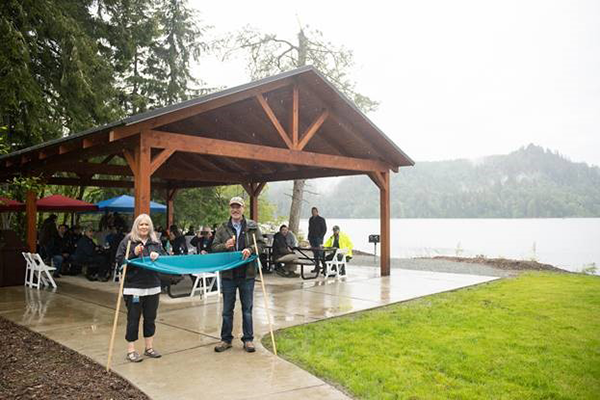
Photo: Pamela Snavely (left), PSE Baker Hydroelectric Project Plant Manager and Tony Fuchs, PSE Consulting Resource Scientist, cut the ribbon at the Lake Shannon Day-Use Park opening celebration.
Questions?
Tony Fuchs
Park Manager
1.888.404.8773
major.projects@pse.com -
Visitor and Interpretation Center
Baker River Club House Visitor and Interpretation Center
Renovated in 2021, the Baker River Club House Visitor and Interpretation Center provides information about PSE’s mission, the hydroelectric project and its facilities, and the cultural and natural resources of the area.
Historic preservationists, archaeologists, and cultural resource experts worked with community, government, and tribal stakeholders to develop a design that honors the original Club House’s character and history. The updated Club House will be a place for visitors to enjoy for years to come.
Hours of operation:
First Wednesday of May through the last weekend of September
Wednesday-Sunday
10:00 AM – 5:00 PM
Before and after


Photo: (Left to right) Pamela Snavely, PSE Baker Hydroelectric Project Plant Manager; Rick Hartson from the Upper Skagit Indian Tribe; Mayor of Concrete, Jason Miller; and Ron Roberts, PSE Vice President of Generation cut the ribbon at the Grand Opening Ceremony in Concrete, WA.
Questions?
Elizabeth Dubreuil, MA, Archaeologist, Cert Arc
Cultural Resources Supervisor
1.888.404.8773
culturalresources@pse.com
Contact us
We welcome your questions and comments. Please contact:
1-888-404-8773
Major.Projects@pse.com