Our TENs program is currently looking for developer partners.

If you would like to find out more about partnering with us sign up for our Developer Partner Webinar on May 19 at 11:00 a.m. PDT or for more information, email TENs@PSE.com  

Sign up HERE for our developer webinar
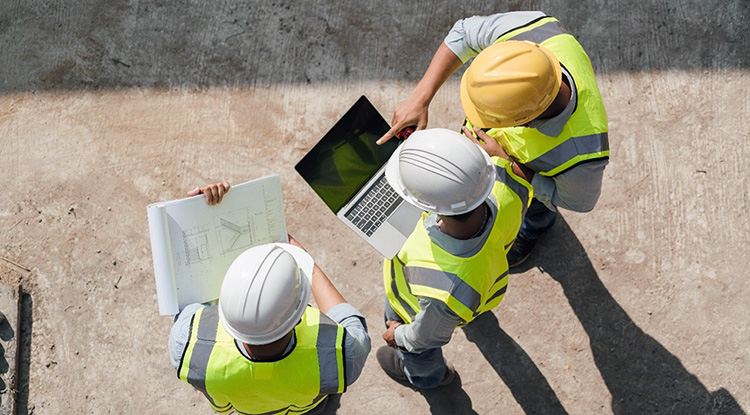
Three workers wearing hard hats and hi viz vests look at laptop screen

Thermal Energy Networks (TENs)

An innovative approach to heating and cooling at scale

Puget Sound Energy is advancing a smarter, cleaner energy future through the development of Thermal Energy Networks (TENs)—an innovative approach that enhances efficiency, reduces emissions, and improves overall system performance. More than just a decarbonization strategy for transitioning away from natural gas, TENs offer a comprehensive solution for optimizing building heating and cooling.

What are TENs?

Thermal Energy Networks (TENs) are designed for building owners and communities navigating rising energy costs, tightening sustainability goals, and aging infrastructure. They are next‑generation, district‑scale heating and cooling systems that connect multiple buildings through underground piping.

How Do TENs Work?

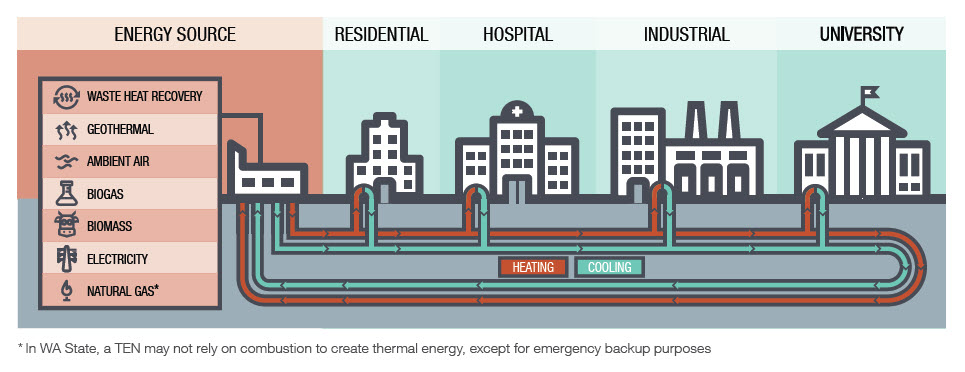
TENs operate by transferring thermal heat across a shared underground piping network that connects multiple buildings, rather than generating it on site. Instead of each building relying on its own HVAC equipment, TENs use a utility‑supported system that circulates fluid through closed or open loop pipes to move heat where it’s needed.

TENs can draw from multiple energy sources across the network. These sources can include waste heat from commercial or industrial facilities, geothermal wells, nearby water bodies like aquifers, or even ambient air. Buildings that produce excess heat send it into the network, while those needing heat draw from it, creating a highly efficient, balanced system.

Thermal Energy Networks Explainer Diagram
Key Benefits of TENs
Reduced carbon emissions

Reduced carbon emissions by shifting from fossil fuel‑based heating to clean, electric‑driven thermal transfer.

Lower operational costs

Lower operational costs through improved efficiency and reduced maintenance.

Enhanced system reliability

Enhanced system reliability through utility‑supported, district-scale infrastructure.

Future‑proof infrastructure

Future‑proof infrastructure designed to meet evolving energy regulations and sustainability goals.

Improved energy efficiency

Improved energy efficiency by sharing thermal resources across multiple buildings.

Load flexibility and demand‑response capability

Load flexibility and demand‑response capability when paired with thermal energy storage.

Eligibility Requirements

The TENs program is currently in a demonstration phase and we are not accepting customer applications. We are looking for developer partners to help develop, finance, construct, own and operate a Thermal Energy Network.

Partners must show they have the organizational strength, technical expertise, and financial capacity to successfully deliver TENs projects.

check-mark
Developers – submit your application to be a project partner by emailing all required paperwork to TENs@PSE.com

We are not currently accepting customer applications.
TENs Frequently Asked Questions
  • What components are required to build a TEN?
    • Thermal energy networks use underground pipes that circulate water to deliver heating and/or cooling at buildings along the network. In Washington State, it is a requirement that a TEN uses no combustion, except for emergency back-up.   
    • Heat exchanging equipment (often called an Energy Transfer Station or ETS) draws waste heat from the shared loop to provide reliable, efficient heating and cooling year‑round.
  • Can TENs be installed in existing neighborhoods?
    • Yes, thermal energy networks (TENs) can be installed in existing neighborhoods.
  • How long do TEN systems typically last?
    • Because there are no moving parts underground and less exposure to environmental forces, TENs can last longer than traditional energy transportation methods.
  • Does a TEN mean you are using a geothermal system?
    • TENs can use a variety of heat sources and are not limited to or required to include a geothermal component. Ambient air, waste heat, geothermal, or other energy sources can be used, and source selection is dependent on a combination of factors including available resources, existing building equipment, and funding levels.
  • How do TENs help reduce carbon emissions?
    • TENs reduce carbon emissions by replacing fossil‑fuel heating such as natural gas, oil, or propane, with clean and efficient electric heating and cooling. Because buildings share energy through a common underground loop, waste heat can be recaptured within the system, often using less electricity than many individual heating and cooling units. 
  • Do TENs increase or reduce demand on the electric grid?
    • TENs can reduce strain on the electric grid over time. Buildings share heating and cooling through a common loop, so rather than waste heat going into the air, it is put back into the network for use in another building. The shared design of a TEN usually results in lower total energy demand compared to running many individual systems.
  • Who owns and maintains the shared infrastructure?
    • Ownership and maintenance of a TEN can vary depending on the community and project. Some systems are owned and operated by a city or town, similar to a municipal water or sewer system. Others are built, owned, and maintained by a private company, either nonprofit or for profit.
  • How do TENs perform during extreme weather conditions?
    • TENs are influenced by weather, but are sized to meet peak demand, and may have natural gas boilers for emergency backup.
  • How disruptive is installation or construction?
    • Installing a thermal energy network does create temporary disruption, similar to other major utility projects. Construction often involves digging trenches or drilling under streets and sidewalks, which can lead to noise, traffic impacts, and occasional access limitations for nearby homes or businesses. Crews may also need short-term access to buildings to connect them to the system. 
    • These impacts are generally short‑term, and once the underground pipes are in place, TENs operate reliably, and with standard maintenance.
envelope icon
Contact us

Interested in learning more about the TENs program?
For more information, email TENs@PSE.com.

Additional Resources

Request for Qualification

TENs 1-pager