


Battery Storage Projects
What role can battery storage play in your energy future? It’s a question we’re excited to answer through a growing number of projects designed for local homes, businesses, and communities. Living in the Pacific Northwest means we have specific energy challenges, just like you have unique energy needs. That’s why our battery projects aren’t simply testing and installing cutting-edge technology. We’re strategically tailoring it to address the things you care about most.
Each project below is forging a path to innovative, flexible, and exciting new solutions – and a better energy future for us all.
Residential Battery Demonstration on Bainbridge Island
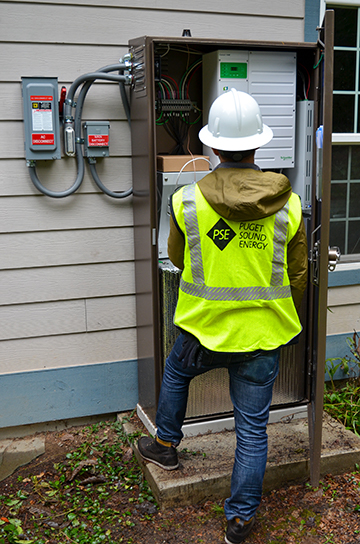
In November 2019, PSE began testing behind-the-meter (BTM)* 6kW/15.5kWh battery units on five Bainbridge Island homes. The goals for this demonstration included evaluating back-up power during outages and peak shaving – which is a term for reducing power consumption on the electrical grid during periods of high demand.
These lithium-ion, consumer-scale batteries are Sunverge One systems that use a proprietary software platform for operation. Mounted on the side of the home, next to the meter, each battery weighs 725 pounds and is stored in a metal cabinet that measures 76 inches tall, 34 inches wide, and 14 inches deep.
Commercial Battery Demonstration at PSE’s Poulsbo Service Center
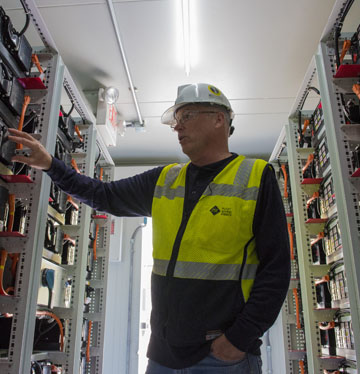
In October 2019, PSE installed one behind-the-meter (BTM) 30kW/183kWh battery at its Poulsbo Service Center. This demonstration is designed to simulate the needs and load profile of a commercial customer and help PSE determine internal processes and operating protocols. The project also offers the chance to test peak shaving and demand charge management, as well as develop a quality customer experience.
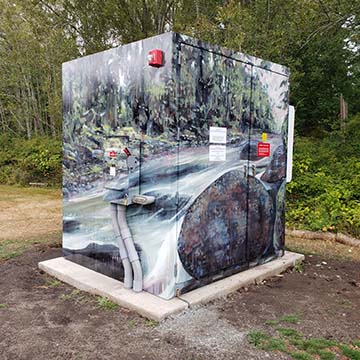
For the Poulsbo battery, PSE partnered with Kore Power (formerly Northern Reliability) to design and install this system that’s housed in a weather-proof cabinet, atop a 7 foot by 14 foot concrete foundation on the service center’s lot. Our plan is to test the battery for at least a year to see how it operates through all four seasons.
Samish Island Community Microgrid Demonstration Project
In 2023, PSE installed a community microgrid on Samish Island. The microgrid consists of a 50 kW / 332 kWh battery and an 8kW ground-mount solar photovoltaic (PV) array in a residential neighborhood with a high occurrence of customer-owned rooftop solar.
This research initiative was specifically designed in partnership with the fire department and local residents to enhance emergency response capabilities. Working hand-in-hand with firefighters and community members, we're gathering real-world data and refining our approach based on their direct input. The project's adaptive framework allows continuous learning and adjustments throughout implementation.
Over the next ten years, we’ll test the system’s ability to form a microgrid and provide back-up power during an outage. This is known as islanding. In 2024, the new microgrid successfully islanded five times. We’ll also test the benefits of pairing a battery with solar to manage the integration of excess solar electricity back-fed to the grid. Additionally, PSE will evaluate other functions like peak shaving, which eases strain on the grid during times of high demand. The results from the testing of this project will inform future battery and microgrid projects developed by PSE.
Tenino Microgrid
PSE plans to install a 1MW/2MWh lithium-ion battery at Tenino’s Blumaer substation. We also plan to install a 150kW solar array on land PSE owns adjacent to the substation. These installations will complement existing solar panels at Tenino High School, creating a microgrid “island” that provides temporary back-up power to the school during an outage. We expect to begin the installation process in 2022.
Glacier Utility-Scale Battery
In 2016, PSE installed a 2‑megawatt, 4.4‑megawatt‑hour battery energy storage system (BESS) next to the Glacier substation in Glacier, WA. The system consists of lithium‑ion batteries stored in four shipping containers.
We built the Glacier BESS as a demonstration project to learn how battery technology could support a small, remote community that experiences frequent outages. We planned to operate this project for about 10 years.
The Glacier BESS provided backup power to 62 customers in Glacier’s downtown area during outages. It also reduced system load and supported grid balancing needs.
Currently, the Glacier BESS is not operating. After evaluating several options, we determined that removing the system in phases is the safest and most effective solution for the community and the site. We plan to remove the BESS in 2026.
* Front-of-the-meter (FTM) and behind-the-meter (BTM) are terms that describe a battery system’s position in relation to an electric meter. A BTM battery provides power on-site, without passing through a meter. FTM batteries are located on the utility side of the meter.
PSE installed a solar array and battery (pictured above) at the Samish Island Fire Station in 2023.

The Glacier BESS consists of lithium‑ion batteries stored in four shipping containers.