

Puget Sound Energy ha presentado una solicitud de plan tarifario de tres años ante la Comisión de Servicios Públicos y Transporte de Washington (UTC). Si la UTC las aprueba, las nuevas tarifas entrarían en vigor a principios de 2027
.Este plan tarifario permite a PSE continuar suministrando energía segura y confiable a nuestros 1.7 millones de clientes, satisfacer la creciente demanda de energía y seguir avanzando hacia los ambiciosos objetivos de energía limpia del estado de Washington.
¿Qué es un caso de tarifa general?
Un caso de tarifa general es un proceso regulatorio formal en el que Puget Sound Energy solicita autorización a la UTC para ajustar las tarifas de los clientes, lo que suele ocurrir cada pocos años. La Comisión lleva a cabo una revisión exhaustiva e independiente de los costos, las inversiones y las operaciones de PSE para garantizar que los clientes paguen tarifas justas por un servicio de energía seguro y confiable
.¿Por qué PSE presenta una demanda por tarifas generales?
El plan tarifario refleja las importantes inversiones de capital que PSE debe realizar para continuar brindando un servicio seguro y confiable de gas natural y electricidad a los clientes, garantizar la capacidad suficiente para satisfacer la creciente demanda de energía y seguir avanzando hacia los requisitos de energía limpia del estado de Washington.
Mantener y modernizar la infraestructura crítica
- Durante los próximos tres años, PSE necesita invertir más de 3.200 millones de dólares en su sistema de gas y electricidad.
- Aproximadamente el 70% de esa inversión se destina al sistema eléctrico, que está sometido a una presión cada vez mayor. Las inversiones en sistemas eléctricos se centran en la seguridad y confiabilidad del sistema, para satisfacer la creciente demanda de los clientes y fortalecer la infraestructura de PSE para hacer frente a los riesgos de incendios forestales y condiciones meteorológicas más adversas .
- El resto de esa inversión (alrededor del 30%) preserva la seguridad del sistema y mantiene la infraestructura actual para los casi 900 000 clientes de gas natural de PSE.
Invertir en energía limpia y generar recursos para la capacidad
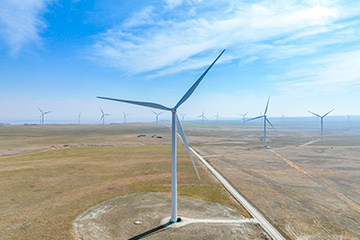
- Según la ley estatal, PSE debe cumplir un hito importante para 2030-2033: proporcionar el 80% de la electricidad a partir de recursos renovables o no emisores. El plan tarifario incluye 11 nuevos proyectos de energía renovable a escala de servicios públicos. Estos proyectos eólicos, solares y de baterías, ubicados principalmente en Washington y Montana, ayudan a cerrar la brecha, pero no cumplen por completo los requisitos estatales .
- El plan tarifario incluye más de 529 millones de dólares en créditos tributarios federales que beneficiarán directamente a los clientes al reducir los costos de los proyectos de nueva generación. Debido a los cambios en la ley tributaria federal, estos créditos están a punto de caducar, lo que hace que sea urgente completar los proyectos rápidamente. Además, los clientes obtendrán un beneficio de 190 millones de dólares en concepto de créditos fiscales para la instalación eólica de Beaver Creek, recientemente finalizada .
- La solicitud también abarca los recursos de capacidad (baterías, turbinas de gas y generación de gas) para garantizar un servicio confiable cuando no brilla el sol y el viento no sopla, y para satisfacer la creciente demanda de energía de los clientes. El
- plan de gastos de capital de PSE para todos los recursos de nueva generación que se están creando para satisfacer la demanda de los clientes y cumplir con los objetivos de energía limpia asciende a más de 3.600 millones de dólares. La recuperación de los costos de estos proyectos se distribuirá a lo largo de décadas .
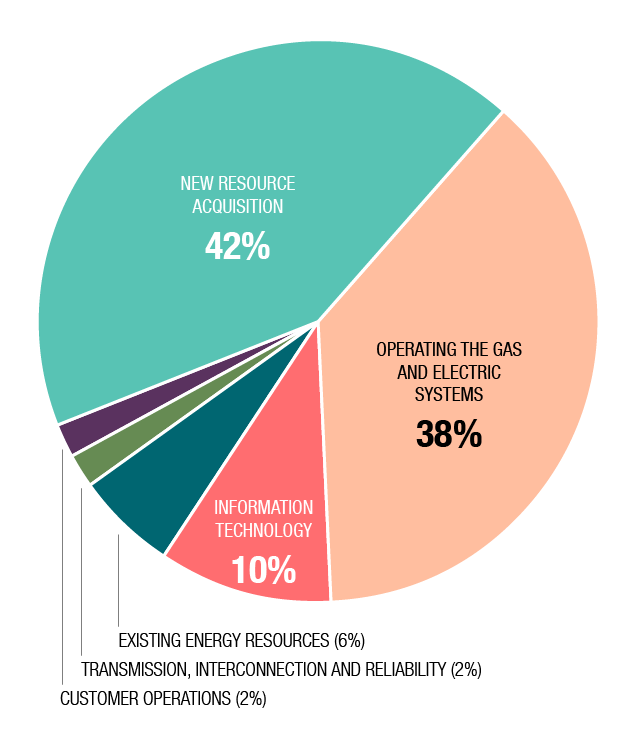
Inversiones de capital para proporcionar energía segura, confiable y más limpia (2027-2029)
-
Obtenga más información
Adquisición de nuevos recursos: los gastos de capital se centran en la construcción de nuevas plantas de generación eólica y solar, baterías y generación de gas natural para cumplir con los objetivos de la Ley de Transformación de Energía Limpia (CETA) y garantizar un suministro de energía confiable a medida que aumentan las necesidades de los clientes. Estas inversiones son fundamentales para que PSE cumpla el requisito de proporcionar electricidad sin emisiones de gases de efecto invernadero durante el primer período de cuatro años de cumplimiento del CETA, que comienza el 1 de enero de 2030, y para respaldar la confiabilidad a largo plazo y el acceso a energía limpia para los clientes .Operación de los sistemas de gas y electricidad: los gastos de capital incluyen mejoras y modernización de los sistemas eléctrico y de gas, reemplazo de cables, modernización de circuitos, automatización, actualizaciones de subestaciones y reemplazo de infraestructuras antiguas. Estos proyectos reducen las interrupciones, acortan los tiempos de restauración y fortalecen la resiliencia de la red ante las tormentas y otras amenazas, garantizando que los clientes reciban un servicio de energía seguro, confiable y de alta calidad todos los días.Tecnología de la información: los gastos de capital abordan la tecnología obsoleta y mejoran las operaciones y la atención al cliente de PSE. Estos proyectos modernizan y protegen los sistemas que respaldan las operaciones y el servicio al cliente de PSE, mejoran la ciberseguridad y mejoran las herramientas digitales para el lugar de trabajo. Al reemplazar la tecnología obsoleta, PSE garantiza que sus sistemas puedan funcionar de manera confiable, mantener la seguridad de los datos y ofrecer una experiencia de calidad al cliente .Recursos energéticos existentes: los gastos de capital respaldan el mantenimiento, la seguridad y la confiabilidad continuos de los activos de generación existentes, incluidas las plantas hidroeléctricas, eólicas y térmicas. Los proyectos en esta área incluyen las mejoras de seguridad de las presas, el mantenimiento de rutina para evitar fallas y el cumplimiento de las normas. Estas inversiones ayudan a mantener un suministro de energía resiliente, reducir los riesgos operativos y garantizar que los clientes se beneficien de una energía confiable y cada vez más limpia .Transmisión, interconexión y confiabilidad: gastos de capital para respaldar la planificación, la interconexión, la resiliencia y la confiabilidad de la transmisión a largo plazo de PSE. Operaciones con los clientes: los gastos de capital respaldan las inversiones estratégicas en la captación de clientes y las capacidades de servicio, incluida la mejora de la atención al cliente especializada para pequeñas y grandes empresas, la facilitación de los recursos energéticos distribuidos (DER), como la energía solar, el almacenamiento y la carga gestionada, así como los servicios de postes, entre otros. Estas inversiones ayudarán a la empresa a mejorar el servicio al cliente, cumplir con las obligaciones reglamentarias y apoyar el desarrollo económico en las comunidades a las que prestamos servicios.
¿Cuáles son los impactos en los clientes?
Si la UTC aprueba la solicitud, un cliente residencial típico de electricidad que consuma 800 kWh al mes verá un aumento en su factura mensual a partir de principios de 2027 de aproximadamente 28 dólares, unos 7 dólares en 2028 y casi 16 dólares en 2029. Un cliente residencial típico de gas natural que utilice 64 termas al mes experimentaría un aumento en su factura mensual de unos 14 dólares a principios de 2027, unos 4 dólares en 2028 y casi 5 dólares en 2029
.Cambios propuestos por cronograma de servicio:
Eléctrico
| 2027 | 2028 | 2029 | ||
|---|---|---|---|---|
| Programar | RY1 | RY2 | RY3 | |
| Residencial | (307) (327) | 16,75% | 3,76% | 8,81% |
| Sec Volt Gen Svc | 08 (24) | 13,69% | 3,64% | 8,46% |
| Sec Volt Gen Med Dem Svc | 7 A (11) (25) | 13,17% | 3,72% | 8,53% |
| Sec Volt Gen Lg Dem Svc | 12 (26) (26 P) | 13,82% | 3,96% | 8,94% |
| Bomba y riego Sec Volt Svc | 29 | 12,35% | 3,90% | 8,74% |
| Pro Volt Gen Svc | 10 (31) | 11,93% | 3,86% | 8,73% |
| Irrigación y bombas Pri Volt Svc | 35 | Proponiendo cerrar | ||
| Pri-Volt Inter Elec SCH | 43 | 13,64% | 4,01% | 9,15% |
| InterSvc de alto voltaje | 46 | Proponiendo cerrar | ||
| Gen Svc de alto voltaje | 49 | 6,28% | 3,99% | 8,50% |
| Comercio minorista | Wheeling | 448 - 459 | 4,73% | 0,00% | 0,00% |
| Contratos especiales | SC | -12,49% | -2,04% | -3,06% |
| Alumbrado público y de área | 03, 50-59 | 32,11% | 3,53% | 9,07% |
| Electrificación del transporte | 558 | 31,56% | 3,48% | 8,93% |
Gas
| 2027 | 2028 | 2029 | ||
|---|---|---|---|---|
| Programar | RY1 | RY2 | RY3 | |
| Residencial | 23,53 | 13,32% | 3,04% | 3,47% |
| Luces de gas residenciales | 16 | 13,64% | 4,00% | 4,73% |
| Comercial e industrial | 31 | 16,84% | 3,62% | 4,13% |
| Gran volumen | 41 | 10,71% | 2,57% | 2,95% |
| Interrumpible | 85 | 7,17% | 1,71% | 2,06% |
| Interrumpible limitado | 86 | 7,43% | 1,48% | 1,66% |
| Interrumpible no exclusivo | 87 | 6,56% | 1,81% | 1,68% |
| Transporte comercial e industrial | 31 T | Proponiendo cerrar | ||
| Transporte de grandes volúmenes | 41T | 22,69% | 3,53% | 3,97% |
| Transporte interrumpible | 85 T | 20,24% | 4,10% | 4,53% |
| Transporte interrumpible limitado | 86 T | 15,36% | 5,37% | 4,85% |
| Transporte interrumpible no exclusivo | 87 T | 26,31% | 4,82% | 5,76% |
| Transporte interrumpible exclusivo | 88 T | 16,50% | -6,08% | 0,00% |
| Contratos | - | 5,17% | 13,52% | 15,52% |
¿Qué está haciendo PSE para mantener bajos los costos?
Reconocemos la presión que el aumento de las facturas supone para las familias y las empresas locales y que nuestros clientes dependen de nosotros para que les proporcionemos un servicio esencial. Nos lo tomamos muy en serio y reconocemos nuestra responsabilidad de mantener los costos lo más bajos posible.
Lo hacemos a través de:
- Administrar nuestros costos operativos: PSE tiene un menor gasto operativo por cliente en comparación con las empresas de servicios públicos de la misma región y de tamaño comparable
- Distribuir los costos de los grandes proyectos de capital a lo largo de décadas para reducir el impacto en las facturas de los clientes
- Participar en los mercados mayoristas de energía para reducir los costos de energía
- Ampliar la eficiencia energética y los programas que reducen la demanda del sistema, compensando la necesidad de adquirir energía para atender a nuestros clientes, especialmente cuando la demanda aumenta y los precios son altos
Además, buscamos aprovechar los créditos fiscales para reducir los costos. El plan tarifario incluye 529 millones de dólares en créditos tributarios federales que beneficiarán directamente a los clientes al reducir los costos de los proyectos de nueva generación. Debido a los cambios en la ley tributaria federal, estos créditos están a punto de caducar, lo que hace que sea urgente completar los proyectos rápidamente. Además, los clientes obtendrán un beneficio de 190 millones de dólares en concepto de créditos fiscales para la instalación eólica de Beaver Creek, recientemente finalizada
.Tengo dificultades para pagar mi factura. ¿Qué puedo hacer?
Estamos aquí para ayudar. Tenemos programas para ayudar a los clientes a ahorrar dinero y energía, y asistencia con la facturación para los clientes que tienen dificultades para llegar a fin de mes.
Obtén más información y comienza en pse.com/gethelp.
¿Cómo puedo obtener más información y participar?
Para ver los documentos completos del caso, visite los expedientes 260005 y 260006 en el sitio web de UTC.
Los comentarios se pueden enviar a la UTC a través de su formulario de comentarios públicos.