


Net Metering
When your solar energy system generates more electricity than your property uses at that moment, excess energy flows to the electric grid. This is known as “exporting”. Through net metering, eligible customers earn credits for each kilowatt-hour (kWh) they export. These credits offset the cost of electricity used from the grid at other times.
How net metering works
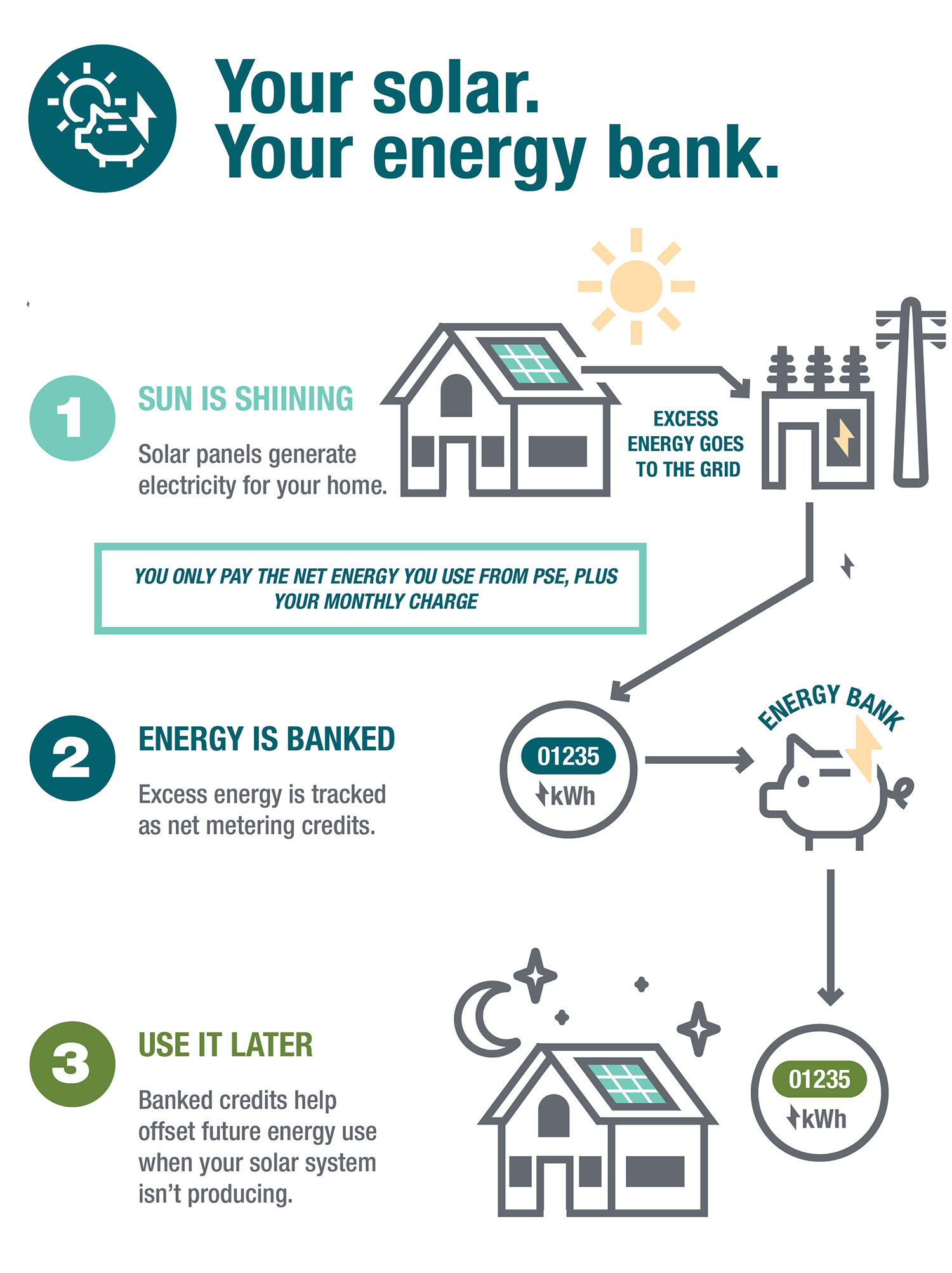
Net metering allows you to build a bank of kWh credits when your solar system produces more electricity than you need and draw on those credits when production is lower.
Later, when your solar system isn't generating enough electricity—such as at night—your home draws power from the grid. The credits you've accumulated can help offset bill charges for that usage. Think of it as making a deposit into a bank of energy when production is high and withdrawing from it when production is low.
Net metering credits are earned on a one-to-one basis. If your system exports 1 kWh of electricity to the grid, you receive a 1 kWh credit to offset charges for future electricity usage from the grid. Per state law, unused net metering credits expire on March 31 of each year.
Who can participate?
Net metering is available to eligible PSE electric customers who install a qualifying solar energy system and complete the interconnection process. Solar systems can be up to 100 kW of installed capacity. For context, the average home-based solar installation is 10 – 14 kW.
Before participating in net metering, your system must be reviewed and interconnected with PSE using the Schedule 150 Interconnection process.
-
Net metering availability
Net Metering, also known as Schedule 150, is open to new participants and will remain until a new rate schedule is in place. For more information, please refer to the Solar FAQs.
PSE Rate Schedule 150 for Net Metering is available to customers on residential and commercial electric service Rate Schedules 7-49. Net Metering is not currently available in combination with:
- Time of Use Rate Schedules 307, 327
- Non-Communicating Meter Service Schedule 171
-
Battery storage and net metering
Adding a battery to your solar system allows you to store some of the electricity your panels generate for later use. Instead of exporting all excess solar energy to the grid, a battery can save that energy for use when solar production is lower.
Battery storage should be considered part of your overall solar system design and must be interconnected with PSE. Customers with eligible battery systems may also be able to participate in PSE's Flex Batteries program.
Learn More About Battery Storage and Flex Batteries
Ready to get started?
Our free personalized solar energy calculator helps you make informed decisions by providing:
- Custom estimates based on your rooftop, energy use, and local incentives
- Battery storage insights to maximize your solar investment and energy independence
- Quick and easy comparisons of different solar scenarios and costs
- Personalized projections to help you understand your potential savings
No commitment required to get your personalized solar analysis.
Estimate your solar potential
Find a qualified installer
Once you understand your solar potential, a qualified installer can help evaluate your property, design a system that meets your goals, and guide you through the interconnection and net metering enrollment process. Before making a long-term investment in solar, we strongly recommend getting multiple bids and selecting an experienced installer. Find a PSE Recommended Energy ProfessionalReady to Interconnect?
Once you’ve selected an installer, they'll help lead you through the process of interconnecting your solar installation to the PSE power grid. The process is as follows:
- Submit an Interconnection application using our online portal
- PSE will review your project submission. If accepted, PSE will issue you an Approval to Construct
- Proceed with solar installation, following local codes and permitting requirements
- After your electrical permit has been finalized, submit your Notice of Completion to PSE
- PSE will come out to test your system for safe interconnection and install any new meters required.
- PSE will issue an approval to energize and initiate net metering
Note that this process is for systems up to 100 kW. For information about interconnecting larger commercial systems, please visit our interconnection page or contact one of our Energy Advisors at 1-800-562-1482.
-
Requirements and guidelines
- PSE System Diagram Guide
- 1218: Electric Service Handbook for Permanent and Temporary Service on Single Family Residential Projects
- 1220: Electric Service Handbook for Permanent and Temporary Service on Commercial, Industrial, and Multifamily
- Reminders about net metering, net metering of multiple systems and net metering aggregation
Installing stand-alone battery or a solar array that is not eligible for net metering? Visit the Interconnection page for details, eligibility requirements, and application instructions.
-
Be a Smart Consumer
Avoid these red flags
- High-pressure sales tactics - “sign today!”
- Offers from companies you did not contact – door to door
- Online ads that sound ‘too good to be true;
- Unclear or confusing proposals that don’t cover everything included
- Financial breakdowns that assume tax credits and rebates
- Companies that attempt to sell you a loan for a solar system, but are not responsible for system install
PSE recommends
- Compare at least three bids
- Financing terms that are clear and separate from project cost
- Financing through a well-established bank or credit union

Have questions about PSE's solar programs and how to get started? We're here to help.