


Solar Energy Credit for your business
Maximize the benefits of your solar investment
When your business' solar array generates more energy than your business uses, that extra energy doesn’t have to go to waste. With PSE’s Solar Energy Credit program, excess solar energy is “exported” to the grid and earns financial credits to reduce future bills.
Whether you're pursuing sustainability goals, managing operating costs or investing in long-term energy resilience, Solar Energy Credit can help your solar project deliver more value.
How it works
- Install a qualifying solar system, of up to 1000 kW AC at your business.
- Use the energy you generate on-site to reduce the electricity you purchase from PSE.
- Export excess energy to the grid when your system produces more than your facility needs.
- Receive monthly bill credits for the energy sent back to the grid.
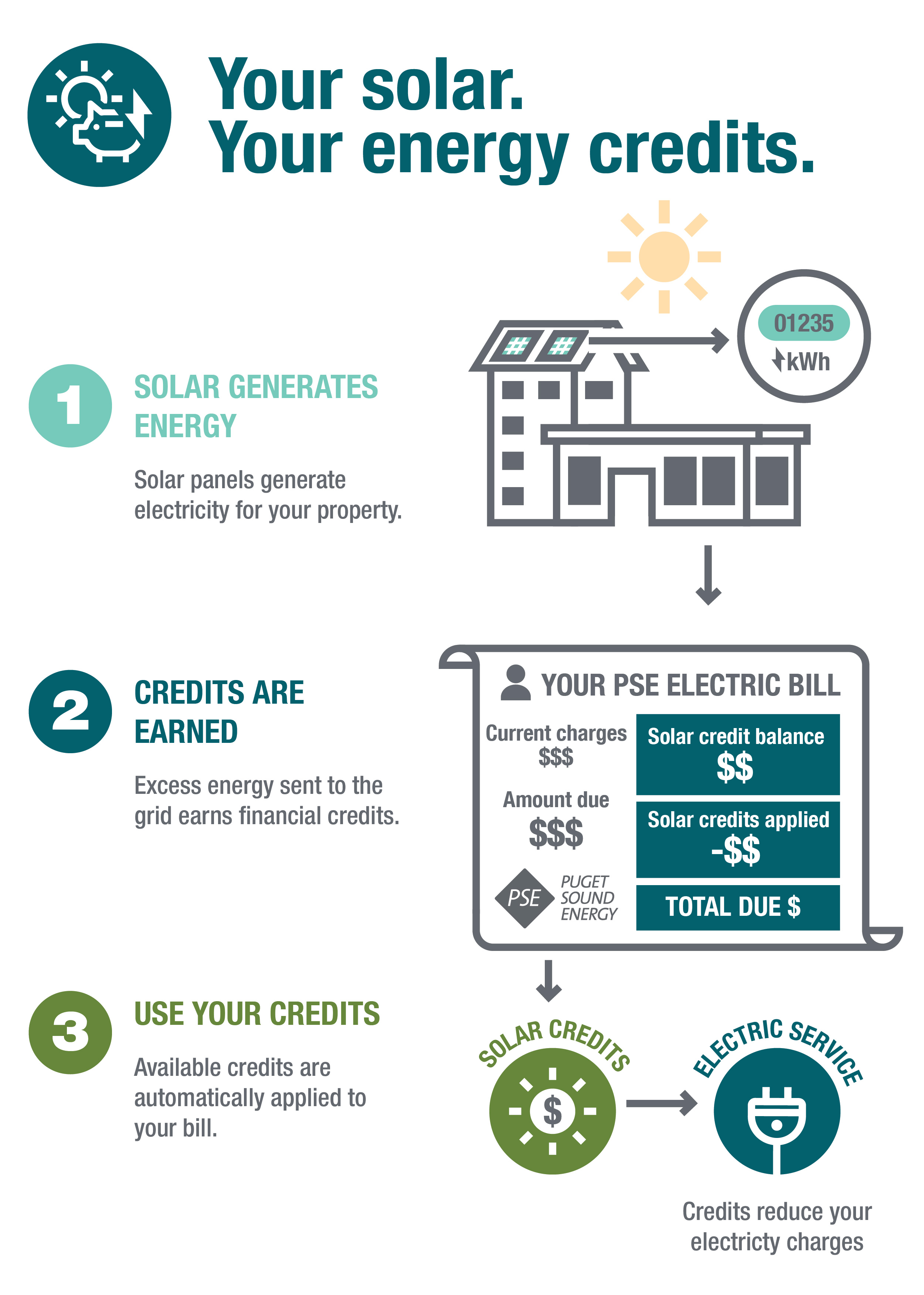
Unlike net metering, Solar Energy Credit provides compensation when there is exported energy as financial credit that appears directly on your PSE bill.
Currently exported solar generation is credited at $0.067 per kilowatt-hour (kWh).
Why businesses choose Solar Energy Credit
Improve project economics
- Reduce the amount of electricity you purchase from PSE, earn credits for excess solar production, and potentially improve project economics by sizing your system to take advantage of economies of scale.
Advance sustainability goals
- Generate clean, renewable energy on-site and contribute additional clean energy to the local grid.
Demonstrate environmental leadership
- Show customers, employees, and stakeholders your commitment to reducing carbon emissions and investing in a more sustainable future.
Support long-term planning
- Solar can provide greater energy cost predictability while supporting long-term capital investment objectives, helping businesses invest in on-site energy infrastructure that complements broader strategies.
-
Eligibility
Solar Energy Credit is available to customers on residential and commercial electric service Rate Schedules 7-49. It is not currently available in combination with:
- Non-Communicating Meter Service Schedule 171
- Time of Use Rate Schedules 307, 327
Before participating in Solar Energy Credit, your system must be reviewed and interconnected with PSE through the Schedule 152 Interconnection process.
Learn about schedule 152 interconnection requirements. -
Enhanced Incentives for community-based organizations, government agencies and Tribal entities
There are limited incentives available up to 100% or $250,000 per approved project to reduce the upfront cost of installing a solar system. Up to $50,000 of the funding can be used toward associated interconnection costs.
Applications for these incentives are reviewed each month and are prioritized by how much of the financial savings from the solar project the applicant will pass on to the communities they serve.
Current and past recipients of Solar Grants or incentives may apply.
To be eligible for Enhanced Incentives, you must:
- Be a community-based organization, government agency or Tribal entity serving low-income and vulnerable populations.
- Have a project located in PSE’s electric service area.
- Own the project site or lease it with a minimum of 5 years remaining.
- Enroll in Solar Energy Credit. For more details of this service, see Schedule 667.
- Receive permission to operate by completing a Schedule 152 interconnection.
- When requested, sign a Solar Energy Credit agreement with PSE.
- Plan to complete installation no later than 12 months after the agreement is signed.
- Have an average of 75% Total Solar Resource Fraction (TSRF) of all points in the proposed solar array.
Next Steps
Before investing in a solar energy system, work with a qualified solar installer or developer to:
- Evaluate your site's solar potential.
- Assess current and future energy needs.
- Estimate project costs, energy production, and payback.
- Determine whether battery storage should be included.
- Complete PSE's interconnection requirements.
Because solar is a long-term capital investment, we recommend obtaining multiple proposals and selecting an experienced installer familiar with commercial solar projects and utility interconnection requirements.
Download the list of PSE Recommended Energy Professionals

Find a PSE Recommend Energy Professional (REP) if you want to learn more about solar or other green options for your home.

Have questions or need help with the solar program? We're here to help