


Commercial Net Metering

Save excess solar generation as energy credits
When your solar energy system generates more electricity than your facility is using, excess electricity is sent to the electric grid. This is known as “exporting” energy.
Through net metering, eligible customers earn credits for each kilowatt-hour (kWh) they export. These credits can be used to offset electricity consumed from the grid when solar production is lower.
How net metering works
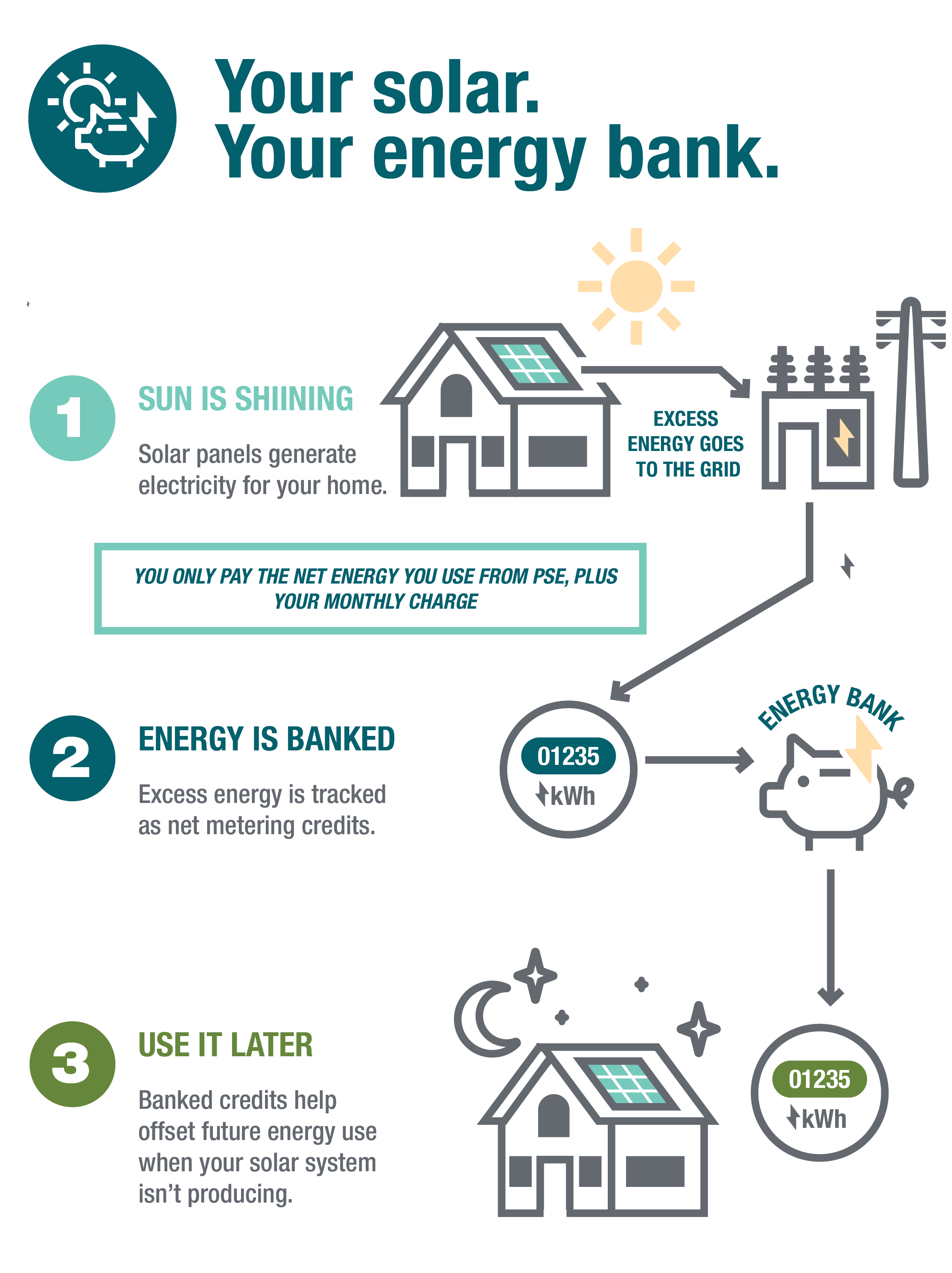
Net metering allows you to build a bank of kWh credits when your solar system produces more electricity than you need and to draw on those credits when production is lower.
Later, when your solar system isn't generating enough electricity—such as at night—your business draws power from the grid. The credits you've accumulated can help offset bill charges for that usage. Think of it as making a deposit into a bank of energy when production is high and withdrawing from it when production is low.
Net metering credits are earned on a one-to-one basis. If your system exports 1 kWh of electricity to the grid, you receive a 1 kWh credit to offset charges for future electricity usage from the grid. Per state law, unused net metering credits expire on March 31 of each year.
-
How do credits work
Net metering credits are earned on a one-to-one basis. For every 1 kWh of electricity your array exports to the grid, you receive a 1 kWh credit that can be applied to offset charges for future electricity usage from the grid.
Under Washington state law, unused net metering credits expire each year on March 31. -
Eligibility requirements
Net metering is available to eligible PSE electric customers that install a qualifying solar energy system and complete the interconnection process.
Before participating in net metering, your system must be reviewed and interconnected with PSE through the Schedule 150 Interconnection process.
-
Net metering availability
Net metering, as described above, is open to new participants and will remain available until a new rate schedule is implemented. For additional information, please refer to the Solar FAQ.
PSE Rate Schedule 150 for net metering is available to customers on residential and commercial electric service Rate Schedules 7-49. Net Metering is not currently available in combination with:
-
Battery storage and net metering
Adding battery storage to a solar energy system allows your business to store some of the electricity generated on-site for use later.
Rather than exporting all excess solar generation to the grid, a battery can store energy for use during periods when solar production is low, such as evenings, peak demand periods or outages (depending on system design).
Battery storage should be considered as part of your overall solar project and must be interconnected with PSE. Customers with eligible battery systems may also be able to participate in PSE's Flex Batteries program.
-
Solar Grants for community-based organizations, government agencies and Tribal entities
PSE’s annual Solar Grant program provides funding for qualifying community, government, and Tribal solar projects, helping organizations reduce energy costs and invest more in the communities they serve.
Next Steps
Before investing in a solar energy system, work with a qualified solar installer or developer to:
- Evaluate your site’s solar potential.
- Assess current and future energy needs.
- Estimate project costs, energy production, and payback.
- Determine whether battery storage should be included.
- Complete PSE’s interconnection requirements.
Because solar is a long-term capital investment, we recommend obtaining multiple proposals and selecting an experienced installer familiar with commercial solar projects and utility interconnection requirements.
See the list of PSE Recommended Energy Professionals that focus on commercial solar

Apply here if you're installing a net metered solar system, alone or paired with a battery. Before you submit your application, be sure to review the requirements and guidelines below.
-
Requirements and guidelines
- PSE System Diagram Guide
- 1218: Electric Service Handbook for Permanent and Temporary Service on Single Family Residential Projects
- 1220: Electric Service Handbook for Permanent and Temporary Service on Commercial, Industrial, and Multifamily
- June 2019 Update: Installation without production meters
- Reminders about net metering, net metering of multiple systems and net metering aggregation
Installing stand-alone battery or a solar array that is not eligible for net metering? Visit the DER Interconnection page for process details, eligibility requirements, and application instructions.

Have questions about PSE’s solar programs and how to get started? We’re here to help.